
On a March morning in 1827, a four-page newspaper appeared in New York City. Called Freedom’s Journal, it declared, “We wish to plead our own cause,” rejecting a press that distorted Black life and defended slavery. Founders Samuel Cornish and John Russwurm saw narrative control as power. That insight shaped the Black press, which later guided migration, shared information, and built community networks. From one paper, it grew into a force that challenged racism, organised resistance, and amplified voices long denied.
From Freedom's Journal to a National Black Press
On March 16, 1827, a short notice appeared in the first issue of Freedom's Journal that announced something unprecedented: "We wish to plead our own cause. Too long have others spoken for us." Samuel Cornish and John B. Russwurm founded the paper in New York City to counter the racist distortions flooding the white press, giving Black readers news about their own communities on their own terms.
Anti-literacy laws across the South made even owning a newspaper dangerous for enslaved people, yet the Black press grew anyway. Abolitionist papers like Frederick Douglass' Paper, launched in Rochester in 1847, merged journalism with direct political advocacy. Douglass understood the press as a weapon, not just a platform.
Upon finishing the Civil War, Reconstruction offered new possibilities. Black-owned papers sprang up in the South and Midwest to cater to the newly liberated. These papers sought to provide certain information and politically readjust in certain places. By the end of the 1880s, Ida B. Wells was using the Memphis Free Speech for an attack on lynching. Editors in the mainstream failed to cover this atrocity. On another occasion, her newspaper was burned to ashes by a mob in 1892-but her writing never died.
These papers provided a service that the white presses would not: they treated Black life as something worth covering, worth dignity, and worthy of support.
Reporting Against Erasure and Organizing for Justice
When white-owned newspapers ignored or justified racial violence, Black editors treated documentation itself as a form of resistance. Ida B. Wells made this principle undeniable. Through her 1892 pamphlet Southern Horrors and her investigative columns in the Memphis Free Speech, she systematically exposed the fraudulent logic behind lynching, presenting evidence that contradicted the rape myth used to justify mob killings. Her reporting forced a national conversation that polite mainstream journalism refused to start.
Wells was not alone in using the press as a weapon against silence. The Pittsburgh Courier campaigned relentlessly through the 1930s and 1940s for military desegregation, running its "Double V" campaign during World War II — victory abroad, victory at home. The Baltimore Afro-American covered disenfranchisement and police brutality with a specificity that white papers never attempted.
These editors understood something about power. Naming violence, recording it, and circulating it among hundreds of thousands of readers was itself a political act. Anti-lynching legislation failed in Congress repeatedly, but the Black press kept the issue alive in public consciousness for decades, shaping how Black communities understood their rights and their enemies. That sustained pressure, built column by column, helped lay the groundwork for the civil rights campaigns of the 1950s and 1960s.
A Community Institution in the Age of Migration and Civil Rights
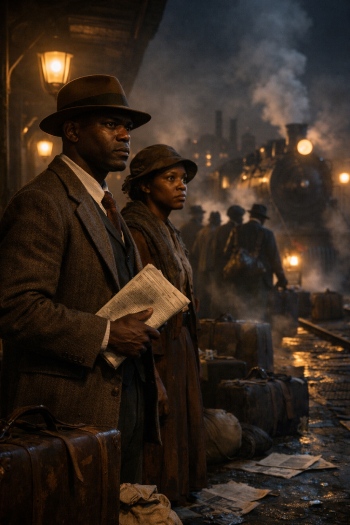
By the early twentieth century, Black newspapers had grown into something far beyond political organs. They were community lifelines.
No paper embodied this more fully than the Chicago Defender. Founded in 1905 by Robert S. Abbott, the Defender actively encouraged Southern Black readers to head north during the Great Migration, running job listings, train schedules, and letters from readers who had already made the journey. Agents smuggled copies into Mississippi and Georgia, where white authorities viewed the paper as dangerous. Some did. In 1919, several Southern towns banned its circulation outright.
The Defender covered churches, baseball leagues, theater openings, and neighborhood business owners alongside its political reporting. Readers saw their lives reflected in print, often for the first time in any newspaper. That sense of recognition built fierce loyalty and a genuine shared public culture across regions separated by hundreds of miles.
When the civil rights movement accelerated through the 1950s and 1960s, Black newspapers covered the Montgomery Bus Boycott, the sit-ins, and the murder of Emmett Till with a depth that white dailies rarely matched. The Pittsburgh Courier and Baltimore Afro-American assigned photographers and reporters to stories the mainstream press ignored or minimized. Columnists like Langston Hughes used these pages to shape public opinion, mourn losses, and celebrate resistance simultaneously.
The Black Press Still Tells the Nation the Truth
African American newspapers were the foremost documenters of Black life, while the mainstream press hardly bothered to pay attention. They created community across segregation lines, exponentiated histories which had been neglected in official records, and redefined a narrow definition of democracy. Ida B. Wells developed a view of lynching through the printed form where others would not, and the Pittsburgh Courier dared to air the Double V campaign in defiance of resistance. This legacy not only remains in modern outlets adorned with names like The Root but is also manifest in local media. As yet, the debate continues over who will get to shape and record American history.
Our Newsletter
With the kind support of
